Remedy's co-op FPS is a fun Control spin-off when everything goes right, though such circumstances can prove elusive early on.
Remedy is a team known for its story-driven single-player games, and though it has tried other kinds of games over the years, FBC: Firebreak is its most prominent detour to date. Built as a three-player co-op PvE first-person shooter set in the Oldest House--the same setting as 2019's Control--Firebreak manages to transpose Remedy's signature strangeness onto something new, and the more I played it, the more I enjoyed it, though it has its fair share of issues.
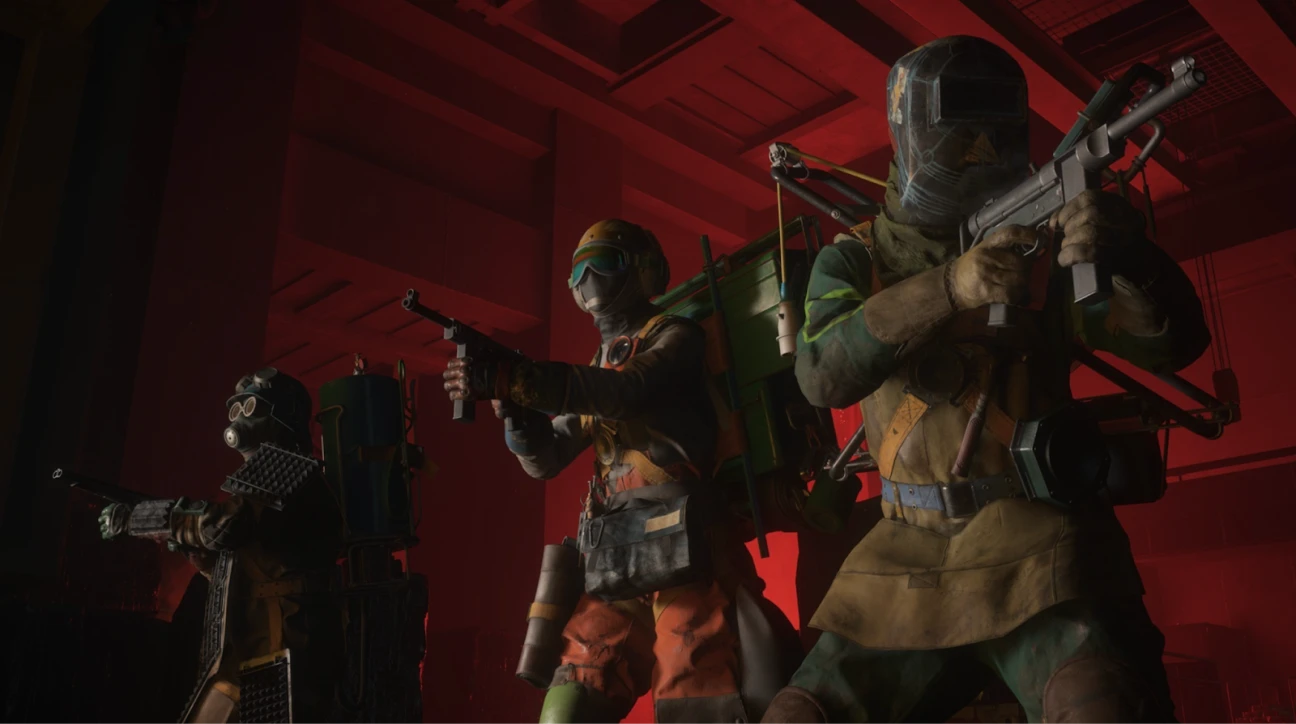
The story casts players as formerly pencil-pushing Federal Bureau of Control (FBC) employees who have no choice but to create makeshift weaponry and gear to combat the Hiss threat they're trapped in the Oldest House with. This premise gives the game a colorful and comedic tone, where expendable player-characters chirp about needing to fill out workplace forms and worry about overtime pay despite the chaotic circumstances they find themselves in. Firebreak sits at the intersection of the FBC's inherent bureaucracy and its impromptu DIY, punk-rock showdown with supernatural monsters. It's a tone that feels decidedly Remedy-like, and its class-based combat does well to match that weirdness.Three "Crisis Kits" make up the game's classes. There's the Fix Kit, which is equipped with a giant wrench and can repair things like lighting, breaker boxes, and healing showers. The Jump Kit, which comes with an electro-shocking contraption that would look at home in Ghostbusters, can be used to shock enemies and power various electronic devices, like broken fans in the game's earliest mission. Lastly, the Splash Kit comes with a big water gun that can shoot bubbles of water to put out fires or dilute negative status effects from one's self or teammates. Naturally, this one pairs well with the Jump Kit, too, as soaking and then shocking enemies can be an effective way of reducing their numbers.On paper, this elemental combat is a clever touch to what could've been a less dynamic gameplay loop. Firebreak is not a shooter in which you can simply point and shoot and be okay. The class-based items matter, which is why it's a bit awkward when, in the game's early hours, they all feel so underpowered. The wrench, for example, doesn't actually dispatch enemies well, so if you think you're selecting the melee role, you are, just not an immediately effective one. That weapon can be enhanced down the line by selecting (and even better, stacking) various perks that you can unlock as you go deeper down the game's progression tree. But when you're first starting out, all three classes feel a bit weak, as do their more typical firearms.
This is especially true of the Jump Kit's shock weapon, which doesn't provide enough audiovisual feedback to make it feel strong in your hands. There's a teaching language that games tend to employ to get the player to feel what they're meant to feel, and Remedy's shooter sometimes lacks that. It's not just the fix or charge meter on the HUD that should tell me when I've performed my class duty to its fullest. The items I'm using and the targets I'm using don't clang and zap in a well-defined manner to make me feel like I'm altering the environment, so they can feel ineffective.
Missions, called Jobs in-game, can exacerbate these early-hour woes. Each Job is split into three clearance levels, which play out as increasingly harder sections, eventually ending in a boss fight or some other finale-style event. Early on, you'll need to complete levels on their first and then second clearance level to unlock subsequent clearance levels. But the first-level-only runs can feel uneventful and very brief, to the extent that if you decided to ditch the game based on that first impression, you wouldn't really have seen what it does so well. At the same time, that signals the game needed to do those introductory missions better as well.
Firebreak's enemy hordes quickly overwhelm players who don't work together as a team, which is why its lack of in-game voice chat is frustrating. Using something like Discord or a platform's own voice chat features resolves this easily enough for a group of friends, and that's certainly the best way to play it, but many will jump into groups with strangers. The ping system can only do so much, and sometimes in Firebreak, it can't do enough.
The resonance mechanic means shields don't recharge if you drift too far away from teammates, but it's easy to overlook that this is how the game is behaving. Games have often put shield recharging on cooldowns, and Firebreak's shield mechanic can be misunderstood as behaving similarly. Likewise, status effects are as easy to pick up as flu-like symptoms at the airport, and players haven't shown an understanding of some simple, universal truths: If I'm on fire, please extinguish it. Some of these pain points are left at Remedy's doorstep to resolve, as Firebreak doesn't always demonstrate its core elements of combat well. Players need to synergize and look out for one another. Often, I've seen players who are on fire or sick from radiation, and the Splash Kit player who could cure them with a few shots of water has no idea they hold such powers.
Luckily, there's always a Plan B, both for players who are lacking a class or two from their group and for players who just can't rely on their teammates to save them. For example, many rooms in any of the game's five Jobs have sprinklers in them, so you can always shoot at those and receive the same benefits you'd get if your teammate were cognizant of how fire works.
All of these factors mean Firebreak's first impression can be a rough one, but I found myself really glad I stuck around for longer, because there comes a point where it turns a corner and it ends up being a ton of fun. Perhaps most important is how the guns feel. Though the low-tier guns feel underpowered--much like the low-tier anything else in the game--they at least point and shoot in a way that feels well designed. The SMG has an erratic kick to it; the revolver packs a massive punch. Eventually, some heavier armaments like machine guns and rifles can be had too, and each provides its own feel in your hands, giving the expected level of weight, power, and accuracy.
I've mainlined the SMG for the most part, and improving that weapon has been super satisfying, as I've watched the recoil dwindle away, allowing me to reliably melt hordes with a single clip. Remedy has mostly made shooter-like games, but never have those mechanics been as much of a focus as they are here. Its past games were more like action-adventures with lots of shooting. Firebreak is a first-person shooter through and through, and it benefits from actually feeling like a good one.
Its best attribute, however, is the attention paid to class builds. The huge perk tree offers a few dozen passive perks, such as faster reloading, heftier melee attacks, longer throw distance, and a lot more. Each perk also has three unlockable tiers, taking them from "weak" to "strong" and eventually to "resonant," thereby giving your nearby allies the benefits of the perks, too. I've found these perks to be massively game-changing and chasing the smartest, most beneficial builds--or sometimes just experimental ones--has resulted in the game really digging its hooks in me over the course of the last several hours I've given it.
I created a melee monster of a Fixer who can get through levels without ever firing his gun. I made a Jumper with superspeed and awesome throw distance, making her an absolute all-star on the Ground Control mission, in which you're collecting supernatural "pearls" and delivering them to a mobile payload device. It feels like I've left the game's rougher parts well in my rear-view mirror now, and even when I jump into a game with strangers who might be new to it and liable to mess up, my characters are often overpowered enough to backpack them to the finish line. I move through the Oldest House like a Prime Candidate, to use a term from the Remedy Connected Universe.
As the game has launched on two different subscription services, I expect some players will likely try it, only to be quickly turned away by a subpar first impression and write Firebreak off without the lack of investment that might keep them around for longer. Hopefully, those who enjoy co-op PvE games do stick around past the early roughness, because there's something really fun to uncover. Sometimes the game gets in its own way by not tutorializing key points, like how to best deal with status effects and play roles dependably. But once you've gained that institutional knowledge, FBC: Firebreak is an enjoyably chaotic power fantasy, and an interesting experiment for Remedy between its bigger, weirder projects.