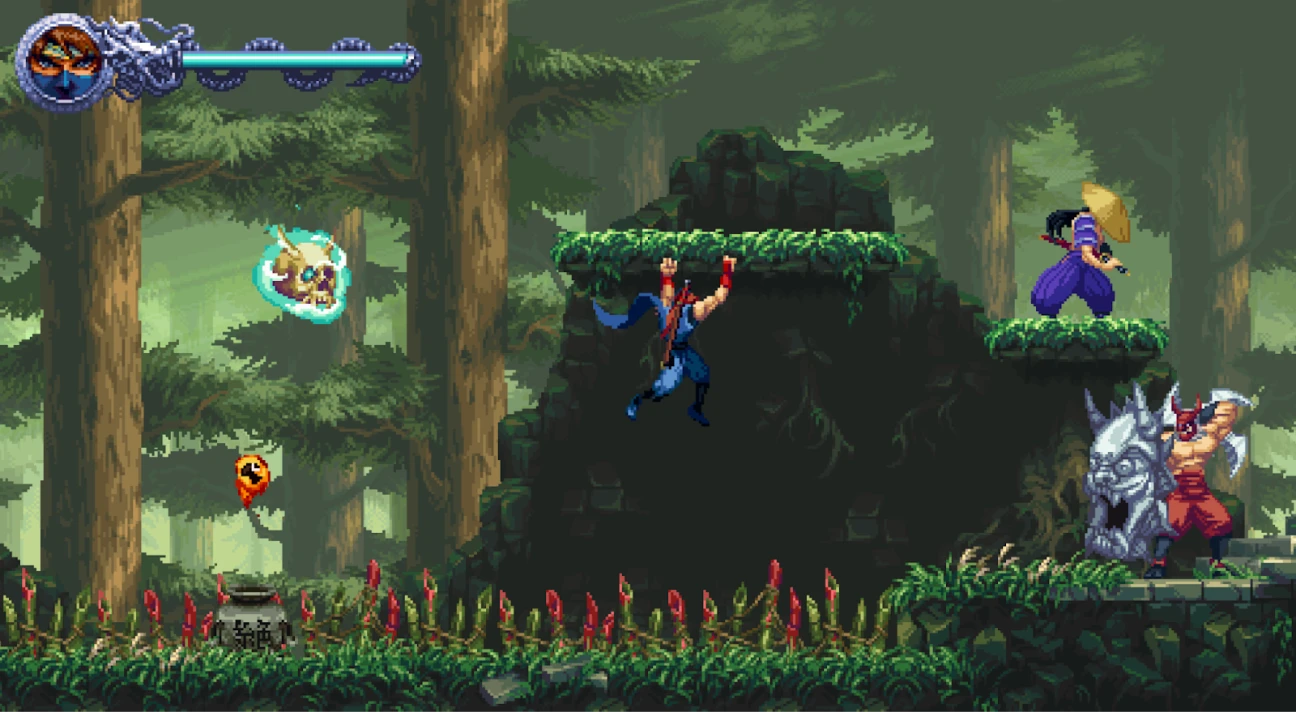
Ragebound is a relentless and challenging revival that ably channels the spirit of early Ninja Gaiden games.
Like the best revivals, Ninja Gaiden: Ragebound feels like it could've come from a different era. Crafted by Blasphemous developer The Game Kitchen, Ragebound is a deliberately old-school action game that captures the essence of the classic Ninja Gaiden series, with sharp gameplay, challenging levels, and gloriously retro visuals and music that would feel right at home on the Super NES. It also builds upon this foundation with some smart new mechanics, making it more than a mere imitation of earlier games.
Rather than putting you in control of series mainstay Ryu, Ragebound follows two new protagonists: Kenji Mozu, an untested trainee of the Hayabusa Clan; and Kumori, a mysterious kunoichi from the rival Black Spider Clan. When Kenji steps in to save Hayabusa Village from a sudden demon onslaught, the pair's destinies become entwined and they form an uneasy alliance, using their combined abilities to stand against the demonic forces threatening the world.
Like so many other aspects of the game, Ragebound's plot is pure Ninja Gaiden: scattershot, nonsensical, and ultimately inconsequential. In their quest to stop the Demon Lord from being unleashed, Kenji and Kumori travel to various sites throughout Japan, battling grotesque monsters, commandeering the occasional vehicle, and eventually becoming entangled in the CIA's affairs. It's knowingly silly stuff, and it affords the developers plenty of opportunities to whisk players through a range of memorable set pieces, from ancient Japanese villages and castles to busy construction sites, flooded pirate coves, and secret military facilities.
The opening acts shift focus between the two protagonists, each of whom has a distinct flavor thanks to the different abilities at their disposal. Kenji plays like a traditional Ninja Gaiden hero, relying on his katana to dispatch foes. Kumori, meanwhile, favors ranged attacks, slaying foes from a distance with her kunai. Both also share a few skills like a dodge roll, which can be used as an evasive maneuver or combined with the attack button to execute a lunge. The actions are fluid and responsive, and both characters feel fittingly acrobatic and deadly.
On top of this basic moveset, The Game Kitchen has introduced a handful of smart new abilities that further enrich the action. Foremost is the Hypercharge. By defeating an enemy with a specific aura (or sacrificing a bit of your own health), you can enter a temporary, supercharged state that dramatically increases the strength of your next attack, felling most foes in a single blow. It's a thrilling addition. Carving through enemies with well-timed Hypercharge attacks as you race through a level is immensely satisfying and reinforces the feeling that you're an unstoppable ninja.
Equally vital is the Guillotine Boost, a spinning kick that allows you to bounce off of foes and projectiles in midair. This move doubles as a defensive measure and a traversal skill; many stages will require you to Guillotine Boost off a sequence of airborne enemies to cross hazards or ascend to a higher section of the level, adding a satisfying touch of platforming to the action.
Partway through the story, Kumori's soul fuses with Kenji, imbuing him with her abilities and unlocking another new skill: the namesake Ragebound Arts. These powerful special attacks can be unleashed after you've acquired enough Rage Orbs, and they're particularly handy during tense situations, such as when you're overwhelmed by enemies or battling one of the game's formidable bosses. You can also purchase and equip different Ragebound Arts as you progress through the game, giving you a bit of freedom to customize your play style.
Despite merging together, the game frequently splits Kenji and Kumori apart, requiring you to use both characters to progress. At certain points in a level, you'll encounter a Demon Altar. Stepping into these will shift control over to Kumori, who must navigate a portion of the stage on her own to reach an otherwise inaccessible switch and open the path forward for Kenji. However, the kunoichi is tied to an energy bar that gradually depletes as you explore, giving you only a brief window of time to complete your objective. It adds a satisfying puzzle-platforming element to the game, as you need to quickly maneuver through a winding section of the stage while also fending off enemies. Fortunately, there's no penalty for failing, so these segments never become frustrating.